


Setting Up for Success
The difference between playing your best golf and worst golf is often much smaller than you realise. Tiny margins dictate how well we perform on any given day. But we need tools at our disposal to increase the odds of playing to the best of our ability.
Every golfer should start with understanding his or her set-up … and focus on this first whenever your shots are not working out.
Let me take you through a few key areas of your set-up to provide you with a blueprint, plus how some variations influence your ball flight.
Set-up Checkpoints from Face-On
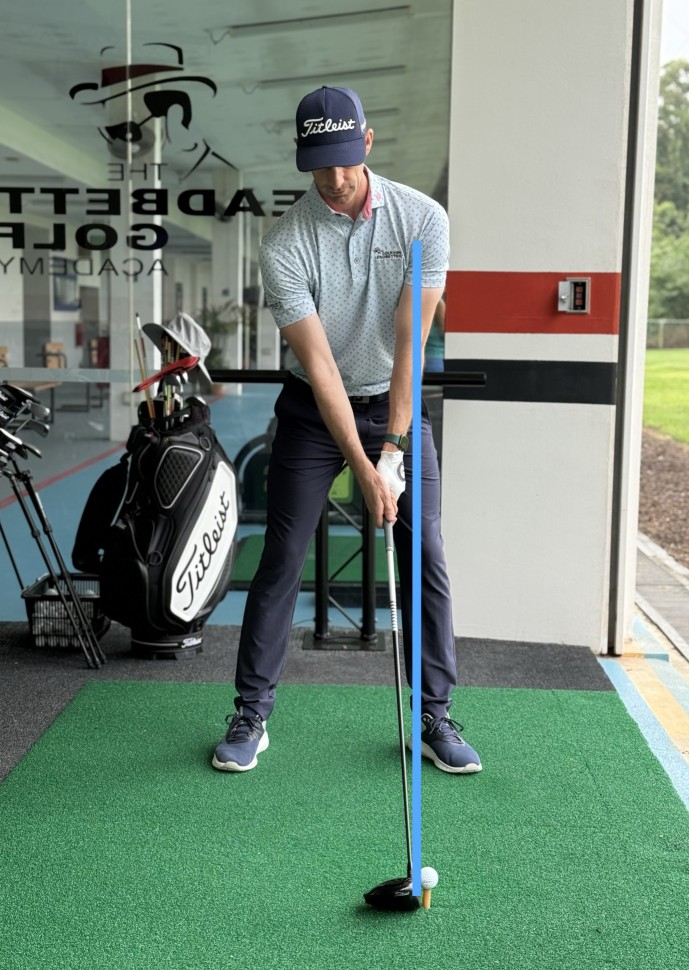

The combination of your ball position and how you distribute your weight between your front foot and back foot will influence your contact through changes in attack angle and direction through club path. For all shots, with the ball on the ground aim to position more weight on your front foot (around 55%-60%), with the centre of your pelvis and chest positioned slightly ahead of the centre of your stance.
Your ball position can be varied depending on the shot shape and height you wish to hit. The more the ball is back in your stance the more you will be able to get a negative attack angle and promote an in-to-out path, but you will also decrease your launch angle
For all shots from the ground, aim to have your ball position around one-to-three balls back of the lead armpit, depending on the club (wedges further back and fairway metals more forward). This should increase your chance of hitting ball before ground. If you’re looking to draw the ball, you should also lean the shaft slightly forward at set-up.
Foot flare is a good idea for nearly all golfers to help with lower body rotation. Ideally, aim for around 10-20 degrees of flare in the feet.
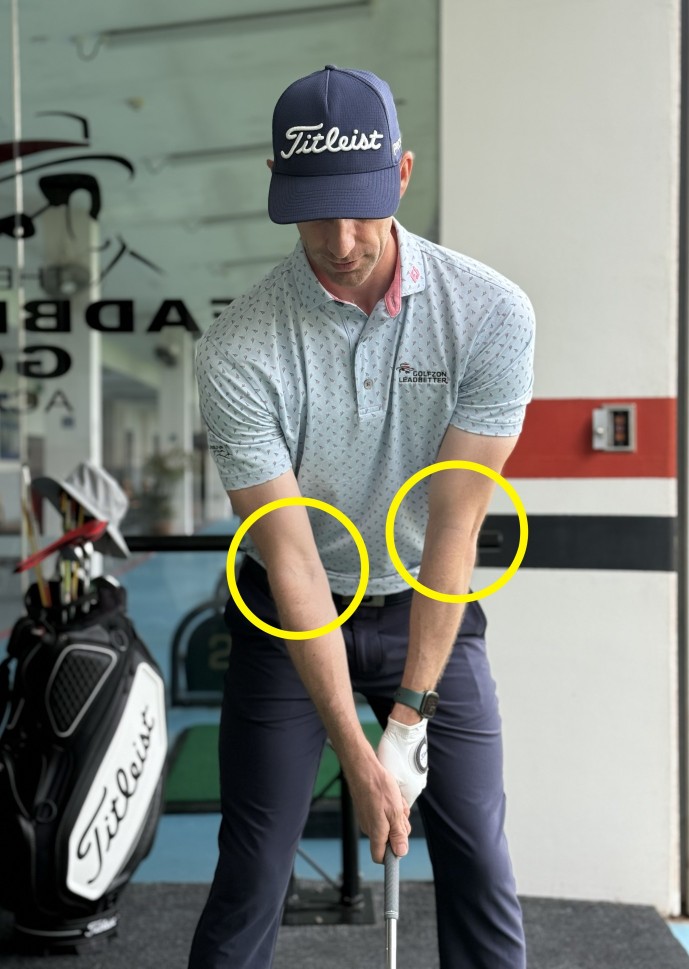
For those of you wishing to hit a draw, the arm structure plays a role. Having the inside of the left elbow look more to the right arm and the inner right elbow look away from you can help pre-set the arm structure to promote a draw and will assist with aligning your shoulders in a position to promote a small in-to-out path.
When it comes to the driver, the ball position can still vary, but more likely under your lead armpit to help create more launch and your weight will be more evenly distributed between your feet.
Set-up Checkpoints from Down-the-Line
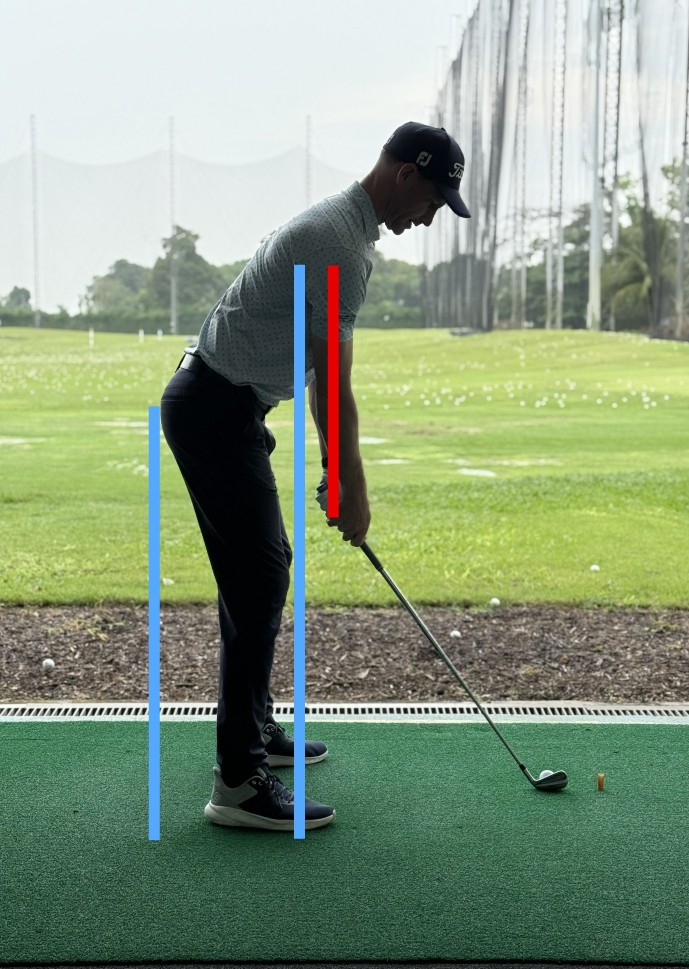
You should aim to develop a balanced set-up around your physique. We are not all built in the same way, so you should strive to achieve a posture that provides the best swing outcomes for your physical build.
Aim to have your pelvis centred over your ankles. This usually gives an image of your buttocks being around one clubhead size behind your heels when looking from behind.
You should be hinged forward from your hips, keeping your spine in its neutral shape, which will generally lead to a position where a line from the back of your triceps should go down and touch your kneecaps and go into the balls of your feet.
For most people this will give great balance for producing a good rotation in the swing. Where your arms hang can vary slightly, with a general rule that arms being further away creates more of a draw bias (think Xander Schauffele), arms closer a more fade bias (think Jon Rahm) and arms hanging more directly down from the shoulder a more neutral shot (think Adam Scott).
Often players only look at their feet as part of their alignment. But the knees, hips, chest, shoulders and arms alignment also heavily influence the swing.
After following the points above, you should always consider how the arms and chest are aligned to support your desired ball flight.
There are many variations we can work with in set-up to create a greater chance of producing our desired outcomes.
Consider checking with your coach on what is best for you so you have your own checklist, or visit the Golfzon Leadbetter Academy at the driving range where our coaches will be happy to help you.